Argon Welding
Argon welding is a welding process well-known in the community, especially in the engineering world. This welding process is known to carry very high health risks, particularly for the eyes and lungs. However, those skilled in argon welding command substantial wages. In this article, we’ll discuss in detail what argon welding is.
Argon welding is a welding process involving argon, a noble gas. Argon is symbolized as Ar in the periodic table . Argon acts as a shielding gas due to its inert nature, meaning it does not react with its surroundings.
These properties make argon gas an ideal shielding agent in welding processes. Argon gas is used in MIG (Metal Inert Gas) and TIG (Tungsten Inert Gas) welding, or GTAW. However, most laypeople refer to argon welding as TIG welding. Here, we’ll discuss several points related to argon or TIG welding.
Argon Welding Equipment
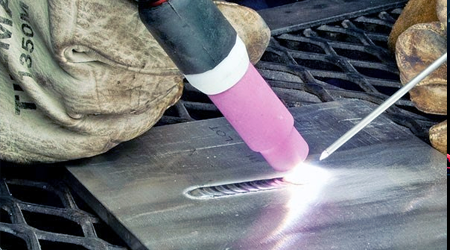
To begin a TIG/Argon welding job, you’ll need some equipment. It requires slightly more equipment than typical electric welding equipment. Comparing stick welding (SMAW) with argon welding, the differences are quite obvious.
The only similarity between the two lies in the welding transformer; most welding transformers on the market can be used for both SMAW and GTAW. Beyond that, there are no other similarities in terms of the equipment required. GTAW equipment includes the following:
1. Argon Welding Machine (Welding Trafo)
An argon welding machine is a machine used to ignite the welding arc. The electricity from the wall outlet is then converted by a step-up transformer circuit in the power source, resulting in a high enough voltage and current for use in the welding process. Welding machine output varies depending on the type. Welding machines can produce direct current (DC), alternating current (AC), or both by simply pressing a button on the welding machine to change the current type.
2. Inert Gas Supply
An inert gas supply is a cylinder containing an inert gas (argon) that supplies the shielding gas required for welding wire. The capacity of this gas cylinder varies, from 1 m³ to 10 m³. Argon is generally used in this welding process. However, helium is also widely used when argon is too scarce. Some GTAW welding processes also use active gases such as carbon dioxide (CO2). Commonly used inert gases come in several purity levels, the most common being welding grade or industrial grade, with sufficient purity standards.
3. Flow Meter and Gas Regulator
The flowmeter and gas regulator are essential components. Besides providing safety, the flowmeter and gas regulator regulate the gas flow rate from the cylinder. The cylinder has an open-close valve to regulate the working pressure. The regulator is equipped with two indicators. The first indicator measures the working pressure and remaining gas volume. The second indicator, a flowmeter, regulates the gas flow rate. Several factors need to be considered to determine the gas flow rate, including the type of gas, the welding position, and the wind conditions around the welding job.
4. Welding Torch (Welding Rod)
The welding torch, or welding rod, is the part controlled by the welder during the welding process. The torch has quite complex components compared to other equipment, which tend to be simpler. On the back of the torch are several inlet and outlet mechanisms, such as:
- Electrode cable is a cable that carries electric current from the welding machine.
- Gas hose which is a protective gas hose.
- The water outlet and inlet hose function to circulate water for torch cooling in the water-insulated torch.
- Torch handle which functions as a welder’s grip during the welding process.
- The cap serves as a cover for the electrode tip, which is usually too long to prevent it from being exposed when an electric current flows through it. This can be dangerous if an unintended short circuit occurs.
- A collet used to clamp the tungsten electrode to prevent it from shifting during use.
- Gas orifice nut is a bolt for placing the gas orifice which functions to spray protective gas into the welding crater area.
- Gas nozzle. This gas nozzle functions to direct the gas spray so that it collects at the welding crater point that requires gas protection.
- A tungsten electrode is the electrode used to ignite the arc. This electrode is a non-consumable type because it has a higher melting point than the material being welded and is only used in argon welding.
5. Foot Pedal Fine Control
This part controls the current used during welding, particularly for GTAW welding, which tends to be complex. The Foot Pedal Fine Control functions as follows:
- Helps ignite an electric arc without having to make contact between the electrode and the parent metal.
- Prevent crater cracks by gradually extinguishing the electric arc.
- Prevent burn through and lack of fusion defects
Also Read: Types of Welded Joints
Types of Tungsten Electrodes in Argon Welding
- Pure Tungsten Electrode (Green)
Pure Tungsten Electrode (EWP) is a pure tungsten electrode with a green color code. It is the most affordable compared to other electrode types. Its only advantage is its price, with its properties not particularly superior. This electrode can be used for welding aluminum and magnesium. - Tungsten Thorium Oxide Electrode (Yellow and Red)
Tungsten Thorium Oxide (EWTh) electrodes are tungsten electrodes mixed with Thorium at a concentration of 1% for the yellow color code and 2% for the red color code. This electrode excels in arc stability and tends to be easier to start. However, thorium is a radioactive element that can have environmental impacts due to waste and health impacts for welders. - Tungsten Cerium Oxide Electrode (orange color)
Tungsten Cerium Oxide Electrode (EWCe) is a tungsten electrode with a mixture of Cerium elements with a content of 2% with an orange color code. The advantage of this electrode is its resistance to heat which prevents melting and contamination. This electrode also produces a stable arc and easy initial ignition, like the EWTh type. But this electrode does not have the radiation hazard of the EWTh type. - Tungsten Lanthanum Oxide Electrode (black)
Tungsten Lanthanum Oxide Electrode (EWLa) is an argon welding wire with a mixture of Lanthanum elements with a content of 1% for the black color code, 1.5% for the gold color code, 2% for the blue color code. It has advantages similar to the EWCe type electrode. - Tungsten Zirconium Oxide Electrode (brown color)
Tungsten Zirconium Oxide Electrode (EWZr) is a tungsten electrode with a mixture of zirconium elements with a content of 0.3% and has a brown color code. The zirconium mixture increases the melting point of the electrode so that it can withstand high currents and is more durable.
How to Weld with Argon Welding
Like other arc welding processes, argon welding shares many similarities with other welding processes such as SMAW, GMAW, and FCAW. The power source is increased by a step-up transformer on the welding machine according to the welding requirements. The electricity is transmitted through two cables, one connected to the base metal (work lead) and the other to the torch (electrode lead).
The current in the cable will only flow when the switch on the torch handle is pressed. As the current flows, a shielding gas will also flow around the electrode.
This gas ionizes when there is a short circuit between the electrode tip and the base metal. The ionized gas acts as a bridge for electrons to move from one electrical pole to the other, creating a stable, burning arc.
Electron transfer involves the separation and combination of electrons from an element. This process generates enough energy to produce heat, which is used to melt the parent metal and filler metal.
Apart from functioning as a connecting medium and arc stabilizer, shielding gas also has the main function of covering the welding crater area from gases that can contaminate the welding crater, such as oxygen and hydrogen.
Factors That Affect Argon Welding Results
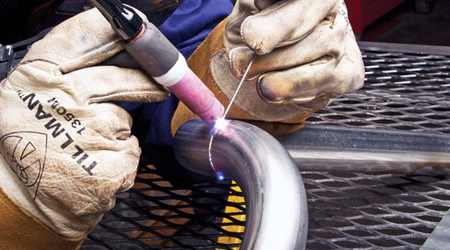
To get strong and good welding results, there are several things that influence it. A welder must pay attention to the following things:
1. Electric Current Settings
The amount of current significantly affects the welding results. If it’s too low, the weld won’t be strong. If it’s too high, the weld will burn.
2. Thickness of the Workpiece
The thickness of the workpiece also needs to be taken into account. The thicker the workpiece, the greater the current strength. Conversely, the thinner the workpiece, the lower the current strength.
3. Gas Pressure
The argon gas pressure is crucial. Avoid setting the flow rate too fast or too slow, as this will significantly impact the welding results.
4. Hand Movements
A professional welder must be able to control his hand movements steadily. He must avoid tremors during the welding process. His hand movement speed must also be steady, neither too fast nor too slow, as this can affect the welding results.
5. Welding Position
There are various welding positions that welders must master, including: Down hand position, Horizontal position, Vertical position, and Over head position.
6. Workplace Environment
Welders must also pay attention to their work environment, whether it’s windy or not. This helps regulate the gas pressure used.
PT Patmanunggal Reka Abadi Welding, Construction and Fabrication Services
Those are the types of welding and their methods, which are popular and widely used in industry and engineering. Experienced resources are needed to complete your projects, such as welding, construction, and metal fabrication.
PT Patmanunggal Reka Abadi is a company providing engineering, construction, welding, and fabrication services. Supported by a professional and experienced engineering team and state-of-the-art equipment.
View our portfolio here
If you are interested and need further information, please contact our sales engineering & marketing team via email or WhatsApp. If you would like to visit our workshop at Jl. Pakel No. 130-131, Banyuanyar Surakarta, Central Java, please contact us.