
Servo Motor
A servo motor is an electric motor designed to utilize a closed-loop feedback system. The servo system influences the input and generates feedback that controls the device. In this case, the goal is to control the motor’s rotational speed, acceleration, and angular position. Servo motors can not only determine angular position but also maintain the load-bearing position according to specifications. This type of motor also has higher torque. The advantage of this servo motor is that it is used in many industrial robot arms, and the position of each angle is programmatically determined and repeated, allowing for continuous operation.
How Servo Motors Work
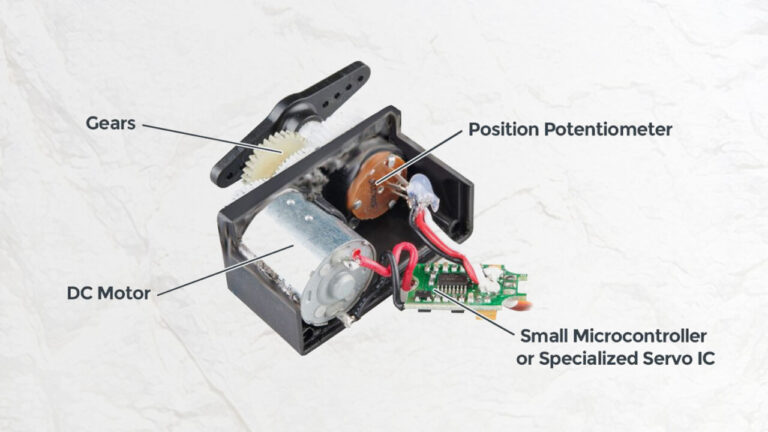
Servo motor mainly consists of:
- DC motor
- Gear Train
- Control Circuit
- Potentiometer
A gear train is connected to a high-speed DC motor. This rotation increases the engine’s torque, resulting in RPM, or speed. A potentiometer is also connected to the gearbox. The gearbox’s rotation affects the potentiometer’s resistance. Because the potentiometer is structured as a voltage divider, it produces a constant voltage output as the engine rotates. This connection provides information about the engine’s rotation angle. To maintain this position, the control circuit requires a PWM ( pulse-width modulation ) signal . The width of this signal is set between 1 ms and 2 ms (milliseconds). When given a signal during this time span, the motor will rotate from 0° to its maximum (180° or 360°, depending on the type). This PWM signal must be given continuously every 20 ms.
AC servo motor
This type uses a highly efficient AC input. These machines are generally large in size and, of course, high in torque. AC servos are often used in large industrial equipment.
DC servo motor
These motors are smaller in size and torque than AC servos. Because they use DC power, input power can be supplied from an adapter or battery. These motors are widely used in various robotic arms and small automation applications.
Types of Servo Motors Based on Rotation
1. Position Rotation
This type of motor’s rotation angle is only 180° and can be adjusted clockwise or counterclockwise. Clockwise is also called CW (clockwise), and counterclockwise is also called CCW (counterclockwise). The motor is equipped with a gear mechanism to prevent the rotation angle from exceeding the limit and to protect the rotation sensor (potentiometer). This motor is commonly used in many robotic arms, both in joints and grippers.
2. Number of Turns
Unlike positional rotation, this type of rotation angle can be adjusted up to 360°. In other words, this motor can be set to rotate continuously like a regular DC motor, but with higher torque. This motor can also rotate clockwise or counterclockwise. To distinguish these motorcycles by their rotational position, you can not only look at the body but also the type of datasheet on the engine body.
3. Linear Rotation
This motor is similar to a positional rotation motor, but with a different gear mechanism. In linear rotation, the gears do not move, but instead move back and forth or vice versa.
This type of gearbox has an additional rack and pinion mechanism to support this movement. These machines are rarely found on a specific industrial scale due to their intended use.
Examples of Servo Motor Applications
- The field of robotics is mainly in joints and robotic arms (grippers).
- Camera tracking
- Solar panel tracking
- Printer and DVD player
- Antenna placement
- Digital camera with autofocus
- Automatic doors
- CNC Router Machine
PT Patmanunggal Reka Abadi Machine Modification, Automation and Engineering Services
That was an introduction to servo motors. In this era of automated industry, experienced resources are needed to complete your projects, such as modifications, engineering, and technical support.
PT Patmanunggal Reka Abadi is a company providing engineering, automation, construction, welding, and fabrication services. Supported by a professional and experienced engineering team and state-of-the-art equipment.
View our portfolio here
If you’re interested and need more information, please contact our sales engineering and marketing team via email or WhatsApp. If you’d like to visit our workshop, please visit Jl. Pakel No. 130-131, Banyuanyar, Surakarta, Central Java. (In front of Red Doorz)