

Types of belts in transmission systems. Belts are one of the main elements in mechanical transmission systems, used to transfer power between two shafts. With their simple yet effective design, belts are a practical solution in various industries, for both light and heavy-duty applications. Below is a more in-depth explanation of some of the main belt types commonly used.
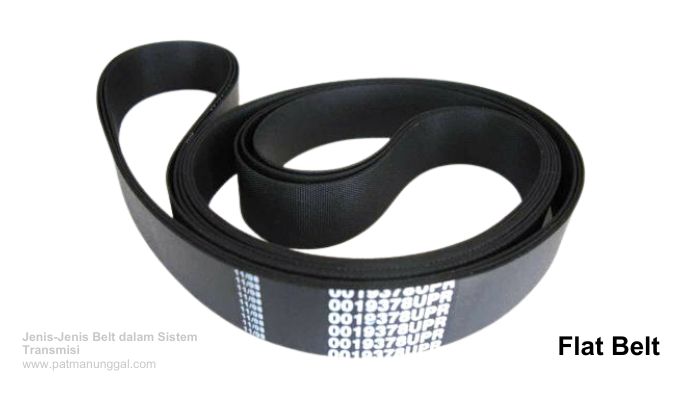
Flat Belt
Flat belts are the earliest known type of belt in transmission systems. Featuring a wide, flat surface, these belts are typically used to transmit power at high speeds and over long distances.
Characteristics:
Flat belts are made of fabric, leather, or synthetic materials with a rubber coating for added durability. These belts work by wrapping around pulleys, and the transmission speed is determined by the ratio of the pulley sizes.
Superiority:
- High efficiency.
- Can be used on long axle distances.
- Simple installation.
Disadvantages:
Prone to slipping under heavy loads, making it less suitable for applications requiring high torque.
V-Belt
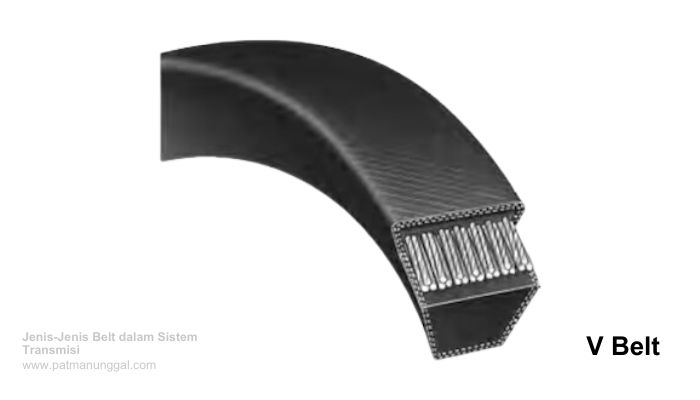
V-belts are designed with a trapezoidal shape to increase the grip between the belt and pulley. These belts are the preferred choice in modern industry because they can transfer greater power than flat belts.
Superiority:
- Stable, with less risk of slippage.
- Capable of transmitting greater power in a relatively small space.
Applications:
Motor vehicle systems, pump engines, and generators.
However, V-belts have limitations in long-distance applications, as they require greater tension to maintain stability.
Timing Belt
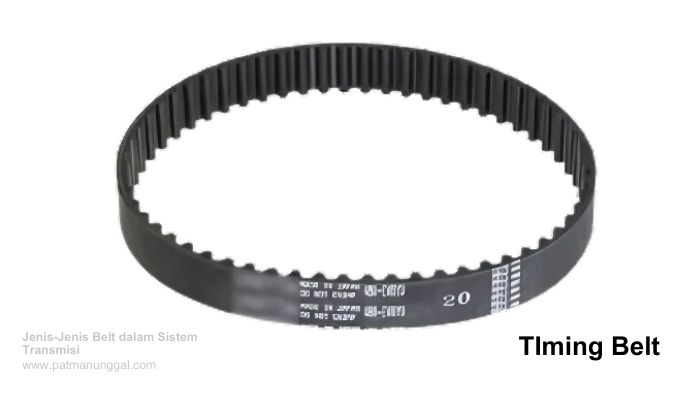
When timing is crucial, such as in a vehicle engine, a timing belt is the best solution. This belt has teeth on its inner surface that ensure perfect synchronization between the drive and driven shafts.
Superiority:
- No slippage.
- Ensures high accuracy in power transmission.
Disadvantages:
Timing belts require precise installation and more durable materials to avoid premature failure.
Ribbed Belt (Poly-V Belt)
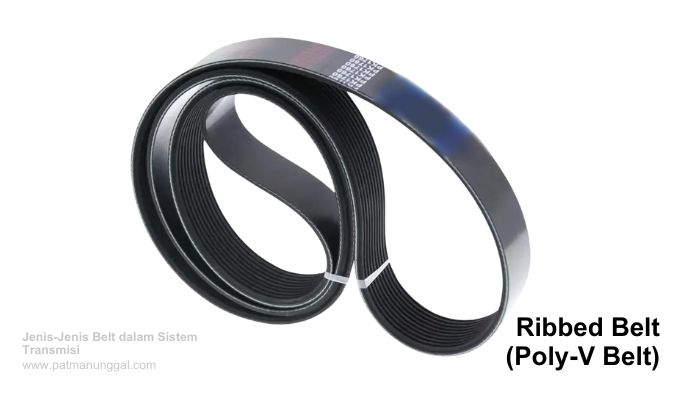
The Poly-V belt is an innovation that combines the advantages of a flat belt and a V-belt. With a ribbed inner surface, this belt is designed to transfer high power with high stability.
Superiority:
- High efficiency.
- The flexible design allows its use on small diameter pulleys.
Poly-V belts are often found in vehicle alternator systems and household machines such as washing machines.
PT Patmanunggal Reka Abadi - Engineering Solutions
Selecting the right belt depends largely on the specific needs of the transmission system. Flat belts are suitable for long-distance, low-power applications, V-belts for medium to high-power applications, and timing belts for high-precision applications. Meanwhile, ribbed belts offer a modern solution for high-power applications with a compact design.
Understanding the characteristics of each belt type can help you determine the best choice, improve system efficiency, and optimize component lifespan. With the right belt solution, your transmission system can operate at its maximum capacity, supporting higher productivity.
If you’re looking for engineering, design, fabrication, and conveyor automation solutions, trust PT Patmanunggal Reka Abadi with your needs . With extensive experience and expertise in this field, we’re ready to help you achieve optimal performance in your operations. Contact us today for a consultation and to find the best solution for your needs. Click here to connect with our team of experts and begin your journey to greater operational efficiency!